Showing posts with label China. Show all posts

11.24.2008

Noodles

We have been eating many noodles these weeks, my husband and I, and I thought that I might tell you a bit about them.

Our favorites are the Asian noodle dishes that we have found in cookbooks and online sources; they are quick to make and, to my husband at least, taste like home. One of the satisfactions of cooking Asian food with an Asian spouse is that at least one person in the kitchen knows what the food is supposed to taste like. Take the dan dan mian, above, which my husband grew up eating from time to time, but I first sampled in Chengdu, Sichuan. Plain wheat noodles are topped with ground pork, cabbage, pickled vegetables, and a spicy sauce of Sichuanese peppercorns (prickly ash), red peppers, sesame paste, soy sauce, and sesame oil. Sprinkle a few green chives or scallions over the mess and you have dinner in a bowl, and an appreciative husband across the table. He made the sauce, I chopped the vegetables, and we could not get over how much these noodles tasted of China -- how much they were China, right there on our little table.

Our chap chae was less successful -- but then again, neither of us really knew what it was supposed to taste like. Our Korean food comes out of recipes, not memories, and perhaps for that reason it fell a little flat. We were missing the notion of how much soy to use, how much sugar and how much shrimp, and though the vegetables were beautifully cut and the noodles were slippery, something was lacking. I liked the dish in any case, but Chuan couldn't hide his disappointment.

Next up for me, when my sister joins us here in Minnesota tomorrow, are home-made Udon noodles. I have a hankering for Japanese food, and found a tidy recipe for the noodles at Cook & Eat. The recipe calls for both regular flour and bread flour, and because I have never made noodles from scratch before, I went to the grocery store this afternoon and purchased a bag of bread flour. I cooked with a wise chef this summer who taught me that it is best to follow the recipe to a T the first time around; after that, if you improvise, you'll know why it worked or why it didn't. I am more of an improvisational cook to begin with, so this dictum is often hard for me to follow, but when I do follow the recipe it does make all of the difference. This is especially the case, I have found, with Asian food, as I have yet to develop a sense of what "works" in a dish and what doesn't. My husband finds the idea of measuring ingredients while cooking Asian food to be very strange, but until I develop the intuition that my mother-in-law has in the kitchen, I will stick by my measuring cups and teaspoons.

Future culinary endeavors: Udon noodles, roast chicken (as I will not be roasting the turkey this year), and onigiri (Japanese rice balls). All this, and I have no idea yet how I will contribute to Thursday's feast!

9.30.2008

Break/fast

Is breakfast a difficult meal for you?

Is it the one that you rarely think about, the one that you linger over the least? I was never one to skip breakfast, but I still find it a hard meal to wrap my head around. I rarely get to lavish the attention on breakfast that I pay to lunch and dinner: hunger, and the morning rush, conspire to make my breakfast as simple as possible. But "simple," I find, is often pre-made and repetitive: store-bought yogurt and granola; toast with peanut butter and banana slices; fruit and cottage cheese. Those are my staples, the ingredients that I always have on hand to make my morning meal in a pinch. I rarely give them a second thought. So what's wrong with that?

Part of the problem with these kinds of foods is that they are sugary and flighty, often leaving me hungry later in the day. And they get boring, day after day, the same combination of dairy and grain and sweetness. There is only so much granola and yogurt that I can take before going batty. Yet I have never been one to yearn for bacon and eggs in the morning -- so what to do?

I have found part of the solution to what-to-eat-for-breakfast in the insight afforded by Asian cuisine which, it should be pointed out, does not draw clear distinctions between "breakfast food" and all the rest. Breakfast, at least in China, may be sweet, or it may be savory; it may have fruits, or eggs, or soup, or rice, or all of these things. Breakfast is like lunch or dinner, only smaller. Just think of all the things you can have for breakfast if you follow this approach! Not just eggs -- pork! Beef stew! Tofu! Vegetables! Are you someone who can't stand another day of bagels with cream cheese and frozen orange juice? Don't you agree that breakfast is the most wasted culinary opportunity of the day?

I'm trying my best to change things around here, and I am taking my cues from Asian cuisine. My breakfast may be a bowl of rice with coconut milk and fruit, as in my first photo, or a sticky rice bao filled with sweet pork, shitake mushrooms, peanuts, and dried shrimp (picked up in Chinatown); black imperial rice with coconut and bananas; mung bean porridge with tangerines; or any other strange and wonderful concoction I happen to dream up or stumble upon. This is what I am eating, more often than not. And I can't think of a better way to start my day with a breakfast that is just a little beyond the ordinary -- even if all porridges look the same.

9.27.2008

Hot pot! (火鍋)

Tonight we went to Chinatown in lower Manhattan to eat huo guo (火鍋)-- Sichuan hotpot -- with some of my husband's classmates. Hotpot is something like fondue, except that instead of oil or cheese, you get a large pot of spicy, steaming broth (and small gas burner) to cook your ingredients right there on the table. Hotpot is one of my favorite Chinese foods; we ate it often in Beijing in late-night dinners that we shared with friends, and Chuan and I even traveled to Sichuan during our time there, before the devastating earthquake. I love the variety of ingredients, the two different ma and la flavors (one makes your lips tingle; the other clears your sinuses), and the communal feel of huo guo.

The one problem with hotpot, for me, is that there are no portions, no courses, and no end to the meal. Even now, when I eat hotpot in New York, I have to remind myself to take my time. And even then I keep telling myself to slow down, to look around, to engage in conversation, to focus on the company, all throughout the course of the meal. Tonight was difficult in that respect, because I didn't know my company very well, and I felt more like a wifely appendage than a dinner companion in her own right. But focus I did, and I got through the meal, occupied more by reminiscences of China than by the conversation.

Coincidentally, the weather today in New York City reminded me of Chengdu, the capital of Sichuan, which is known for its humid, foggy weather, its beautiful women, and its spicy foods. Lower Manhattan was covered in fog and mist this evening; we could have been eating hotpot in any Chengdu eatery, and no one would have known the difference by stepping outside onto the city streets.

All of Sichuan, in my memory, appears wet and flowing, its rivers and fragrant broths confounded. In Chinese, "sì chuān" means "four rivers," and the province is indeed criss-crossed by waterways. Sichuan, even inland, is a land of water. (My husband's name, Chuan, comes from the same word: 川 in Chinese.)

We ate wonderful mushroom hotpot in Chengdu's restaurants, and visited poetic shrines and ancient battlegrounds, but we both agreed that the most interesting part of Sichuan was further north, closer to the border with Tibet, where yak's milk replaces tea as the most common drink.

These photos are from Jiu Zai Gou ("Nine Villages"), a scenic area in the mountains of Sichuan. Most of the people who live there speak a language that is closer to Tibetan than to Mandarin, and many are practicing Buddhists. We visited in autumn, right before the trees changed colors, and spent several days living with one of these families in the foothills of the Himalayas. I remember waking up early in the morning, seeing my breath hover above the comforter, and hearing the faint sounds of gongs -- monks in prayer.

In China, we visited Buddhist shrines and paid our respects to the ancestors (Chuan's ancestors) wherever we went. I remember standing side by side with the man who would become my husband, burning incense and lighting candles as offerings. I knew that it was right that we were there together, a man born in China showing a woman from Minnesota how to approach the shrine. And then I told him something, about what the Buddhist images meant -- the wheel, the lotus, the knot-- and how Tibet and China fit together (or didn't) in Buddhist history.

These things were going through my head tonight as I watched the last pieces of mutton go into the hotpot; as I debated whether to eat more or to stop; and as I paid polite attention to the conversation around me. All of these things made up my meal, in Buddhist fashion, the past coming to greet the present, the present looking towards the future. And if that isn't a good meal, a pleasant communion, I don't know what else is.

-- 艾鹭 (Aì Lù)

9.21.2008

Second ode to bread

I haven't left my apartment all day -- oh, what a marvelous Sunday! In between bouts of neuroscience studying, I made Chinese sweet buns (bao zi):

Now that I am eating wheat again, I can return to baking. My husband used to joke that the fact that we used our oven exclusively for storage meant that we were just like the typical Asian immigrant household. Most Asian food is cooked exclusively over the stovetop, so many Asian immigrants in the U.S., like my mother-in-law, devise other uses for the oven space. For a long time, when I was staying away from wheat, I didn't use my oven, either.

Dough rising
All of this lead up to say that I wish that I had baked something wonderful in our oven today, but the buns that I made were steamed -- a perfect example of how ovens are completely expendable in Chinese cuisine. Nevertheless, they gave me the satisfaction, at least, of letting me pretend that I was baking, as I kneaded and coddled the dough for a couple of hours before filling and steaming the buns.

Steaming the buns
I made two sweet pastes to fill the buns: red azuki bean paste and black sesame seed paste. This recipe, from The Essentials of Asian Cooking, provided me with the excuse to use the red azuki beans that we got in Flushing last weekend and to try the freshly-milled flours from Wild Hive Farm, courtesy of the Union Square Farmer's Market on Friday. And I can never pass up an opportunity to eat sesame:

Filling the buns
I haven't kneaded bread since I was a high school exchange student in Chile and a friend's father taught me to make pan amasado. Chile has been on my mind a lot recently. September 18 is the Chilean Independence Day, a time when Chileans get together with friends and family to fly kites and eat barbecue; I was reminded again of this on Friday, when we had a Chilean couple over to wine and cheese. I spoke Spanish the whole night long. It is always a great joy and relief to me to be able to return to Spanish and find it as much unchanged as when I last left off. And Chilean Spanish I may understand best of all, for it was in Chile that I learned to speak Spanish, and I still sometimes betray a bit of their accent despite all of my time in Argentina later on.

I also found out, just yesterday, that my Chilean host father is terminally ill, so he was on my mind, too, as I went about my tasks today. As I kneaded the bread I thought of my host family, and their lives, and my family, and our lives, and all that has happened since I came back to the U.S. for the first time, seven years ago.

I wanted to write more here about China, and Chinese breads, and what I did for lunch (which you can see above), but it seems better to leave off now with a few verses from the Chilean poet, Pablo Neruda, and call it a night:

Ode to Bread


Bread,
you rise
from flour,
water
and fire.
Dense or light,
flattened or round,
you duplicate
the mother's
rounded womb,
and earth's
twice-yearly
swelling.
How simple
you are, bread,
and how profound!
You line up
on the baker's
powdered trays
like silverware or plates
or pieces of paper
and suddenly
life washes
over you,
there's the joining of seed
and fire,
and you're growing, growing
all at once
like
hips, mouths, breasts,
mounds of earth,
or people's lives.
The temperature rises, you're overwhelmed
by fullness, the roar
of fertility,
and suddenly
your golden color is fixed.
And when your little wombs
were seeded,
a brown scar
laid its burn the length
of your two halves'
toasted
juncture.
Now,
whole,
you are
mankind's energy,
a miracle often admired,
the will to live itself.

9.12.2008

Mid-Autumn, Mooncakes, and Fermentary Madness

We will be spending this weekend at our in-laws', where we'll celebrate the Chinese mid-autumn festival in great style (I imagine), reciting poetry and eating special cakes under the moonlight as inhabitants of the Middle Kingdom have been doing for at least four thousand years. My mother-in-law knows how to prepare all sorts of delectable Cantonese dishes and sides, and I can only imagine that, as always, the spread and board will be abundant for the four of us.

This year, the timing for the Mid-Autumn festival couldn't be better, culinarily speaking: in the last few weeks Chuan and I have sampled almost every Asian culinary tradition except his own. We have eaten pad thai and bubuh injin (Indonesian black sticky rice pudding, above), soba with mushrooms, beef satay, kimchi and ramen noodle soup, daikon pickles, Japanese zucchini salad, and Korean-style vegetables (below). These recipes are all courtesy of Corinne Trang's Essentials of Asian Cuisine,and were all made in a New York kitchen the size of a mid-size SUV. But oh what flavor! And what surprise, too, for both of us, that such meals should be so easy to prepare. 

This happens to me again and again: I imagine that a dish or cuisine that I have eaten at a restaurant is somehow impossible to replicate on my own, as if those chefs or cultures held some special knowledge that I don't possess. Now I know the truth, and it is so simple: if I can find the ingredients and read the recipe, I can make just about everything -- and it is usually better than what I find in the stores. 

With Asian food, unlike some forms of European cuisine, it is not the recipe that presents the difficulty here, but rather sourcing the ingredients. It makes all the difference in the world, I have found, to have the right kind of soy sauce and to have, on hand, all the sorts of things that a pan-Asian kitchen calls for, such as: fish sauce, tamarind, sesame oil, Thai chilies, mung beans, etc. I went to a lot of effort last week finding these ingredients in different neighborhoods in Manhattan, from the little stretch of Japanology on Stuyvesant Place to Kalustyan's Asian emporium in Murray Hill ("Curry Hill"). I had never been into most of the stores that I visited, so part of the fun was being able to wander the aisles and discover things that I had never imagined eating before. Have you ever tried candied squid? Fermented plum paste? Pink sea salt? When I think of the American diet, the variety and the fusion of different cultures always comes to mind, but stepping into a Japanese or Korean market and seeing the staple foods of these communities makes me aware of just how much more food is out there, and how many more ways there are to eat.

I am especially intrigued by the use of fermented foods in Korean and Japanese cuisines. Not only are they easy to make (Can you slice vegetables? Can you pour water? Can you measure salt? Then you can make Asian pickles -- seriously!), inexpensive, and tasty, but they supposedly aid in digestion. All that, from cabbage and carrots and peppers and bean sprouts! You can just see our pickled daikon in the upper right-hand corner of the photo above, peeking out of a white ramekin. I'm sure we'll finish the lot off tonight, along with some beef broth and bean starch noodles.

When my digestive problems first began about four years ago, at the same time that I was emerging from my eating disorder, I received advice from a dietician to eat as many (naturally) fermented foods as I could, to help stabilize my digestive enzymes. Whether or not this actually did anything to get my juices moving again, I'll never know for sure, but a funny side effect was that I was probably the only person living in Brazil who was making huge vats of kimchee (Korean pickled cabbage) for her own consumption. I love this about cooking: that by making food from another place, you establish a connection with that place, no matter where you happen to be, geographically- or metaphysically-speaking. In Brazil I made Asian pickles; here in New York, I long for the scallion pancakes and mutton skewers of Beijing's streets, the coconut moqueca stews of Bahia, and the polenta of Argentina. 

The kitchen beckons. What will I make tonight? Where will I visit? Which memories will I stir up?

9.07.2008

Where food is medicine

This week my husband and I both started our doctoral programs. We have five (+) long years ahead of us, and already our lives are busy like they haven't been since our undergraduate days: long study sessions in the library; excuses when friends suggest meeting up; little time for day-dreaming; and meals grabbed on the fly.
 
This last point, as some of you may know, is of particular worry to me. I have spent so much time learning to pay attention to food that I cannot easily give up the central place that food, and its preparation, have played in my life during the last few years. I know that my studies will cut down on the amount of time that I can be a butcher, baker, and candlestick maker, but I am not quite ready to cede that time.

Thus, right when I should be focusing on other
 things, I find myself absolutely fascinated with Asian cooking. My bedtime reading of Corinne's Trang's Essentials of Asian Cuisine certainly is not 
helping matters, nor is the amazing Korean kimchee soup that I made last week, or the pad thai and watercress that were tonight's dinner:


My husband and his family are from China, and although he grew up eating Cantonese fare, most of what we cook together is Western in inspiration -- a bias that I am working actively to change. The months that I spent in Beijing with Chuan before we got married were amazing, foodwise and otherwise, and I am surprised that it took me this long to decide to try to replicate some of the recipes that we had there, like noodle soups and dumplings, sticky rice with pork and green bean congee. My first forays into food exploration (rather than restriction) began in Beijing, where I must have been the only foreigner who didn't long for ketchup and cheese and wine; indeed, I felt no inclination whatsoever to eat any of these foods, and set my sights on more interesting dishes, like jiao zi (dumplings), Peking duck, 
huo guo (Sichuan hot pot), and skewed beef and yogurt, Uiguhr-style. We lived in a neighborhood near Tsing Hua university, where lots of Japanese and Korean students studied, and so we learned how to eat Korean barbeque and consume large bowls of udon soup. In short, we ate well.

Perhaps the food in Italy this summer was so beguiling to me that I overlooked how deeply Asian food -- its preparation, presentation, and consumption -- speaks to me. From scallion pancakes made by street vendors in Beijing, to the pungent aroma of Korean pickles, to the austerity of Japan's sake and soba, there is something -- what is that? -- that I love about Asian cooking. 

I love the sense of balance that the cook strives for in every meal, the attempt to include sweet, salty, bitter, sour, and spicy tastes in every banquet, and various textures and colors, too. I love the idea, inherited from traditional Chinese medicine, that food is medicine, that food is 
the first medicine, and everything else is a second resort. I love the way my in-laws drive half-an-hour for groceries in order to find the freshest fish and right kind of dried mushrooms and shriveled scallops, and the way my husband slurps his soup and always, always, has second helpings of rice.

In China, where most meals are served in banquet fashion, one large plate after another placed on the table for all to nibble on, I learned to pace my meal and eat only what I needed (what some call "eating intuitively"). I began to listen to what my body really needed when I sat down for a meal, instead of planning out every 
morsel ahead of time. Often I didn't even have the words to order my own food, so when the meal came, I had to eat what was before me. Not knowing what to expect, I loosened up a bit. So what if I ate something that I didn't want to eat? So what if that dumpling was made of wheat, not rice? So what if I over-ate or under-ate at one meal? I would get another chance, and the next meal would be something different, likely something that I never had eaten before. 

And so my eating changed, bite by bite. I left China and never looked back -- until now. In our home, Asian food is comfort food, and so I'm back to scouring the shelves of supermarkets looking for mirin and chili paste, dried shrimp and rice noodles, just as classes start and more responsibilities pile on. We are far, geographically speaking, from the rice paddies of our photos, but could not be in greater need of the reassurance afforded by a simple bowl of rice.

5.26.2008

C O L O R

Since I began to knit again last year, I have found myself drawn to the color of yarn with such intensity that it sometimes startles me. I might spend an hour in a yarn shop staring at the shelves of yarn and pawing at one skein after another before, disappointedly, I admit that I can't find what I want, and won't settle for second-best.

Whence this love-affair with color? I was never the painter in my family; I preferred music and books to drawing and sculpting. Yet, the passion that I feel from color must have come from somewhere, or some time when my eyes were open wide enough to see.

The first time I remember feeling a certain way about color was when we were living in China; I became fascinated by a certain shades of brick orange and dark, deep yellows -- similar to the yellow in this ball of yarn here, the shade of goldenrod.

Perhaps I dreamed of colors because, for the first time in my life, I could not speak or understand what was spoken to me -- or, rarer still, what was written. Chinese characters on store-fronts and roadways might as well have been drawings to me, for that is how I interpreted them. Neurologists believe that, when one part of the brain is injured, other parts learn to function in its stead; a small miracle. But forget lesion -- what happens when a faculty is not injured, but instead rendered useless, as was my ability to speak and interpret speech in China?
There, I spent a humbling half-year deaf and dumb, but enchanted, nonetheless, by the smells and the tastes and the sights -- as if they could make up for my voicelessness. Those colors, like the yellows and green of the clay Buddhas at the Fragrant Hills, find strange parallel in the yellow yarn and green grass of the photos that I took yesterday at the Cloisters.

It took China for someone like me, enamored of languages and other sounds, to let go of words and explanations long enough to start seeing the patterns in front of my own eyes: the gray stones of the old hutong neighborhoods around the Forbidden City; the swirl of rice noodles in beef broth; the swoosh of the Beijing subway as it circled the outer boroughs; and the swinging wicker cages that old men would carry along to "walk" their birds. I sought an older, imagined China, growing more nostalgic for it even as the people around me looked ahead, towards the Olympics that are, now, almost upon us. I looked backwards, towards temples and emperors' gardens and pleasure grounds; they anticipated that the Middle Country would rise again, and prepared for it.

What does all of this have to do with my knitting? I didn't knit in China, and I never saw anyone knitting there, although my mother-in-law says that she used to knit her own sweaters after the Cultural Revolution, when everyone learned to make do. No, knitting doesn't have a lot to do with China, but I believe that color does -- or, at least, it has to do with my version of China, imperfect and fragile and beautiful in its wordlessness. I'm sure that, had I stayed longer and learned more Mandarin, some of the charm of incomprehension would have been lost, and I would have begun to read signs as words, not drawings, and look for a label for every passing sensation. Instead, I remained eyes-open, childlike in my delight and appreciation. Something of this same feeling I have now, when I grasp a yellow ball of yarn, take a strand between my fingers, and cast on for another project.

No words -- just yellow.

5.07.2008

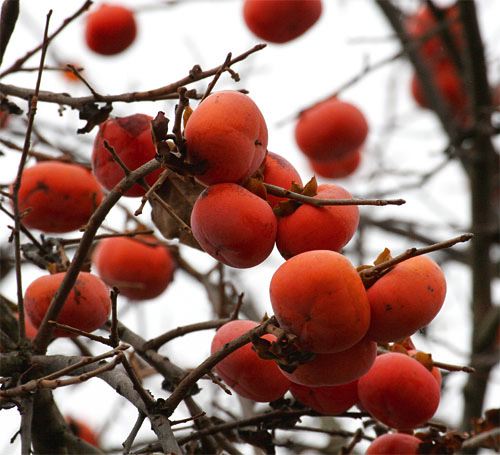
Persimmons


Persimmons, or Caqui in Portuguese: I first ate them in Beijing two years ago, when my husband and I were living in a tile-floored apartment in a student neighborhood near Tsinghua University. Once my Mandarin improved enough so that I could understand the prices that the fruit sellers quoted me, I bought them fresh by the half-dozen, and stored them at the back of the refrigerator for late-night feasts.

Cool, glistening orange purses, they reminded me of Lorca's injunction not to eat oranges under the moonlight -- nadie come naranjas bajo la luna llena -- but would the poet have allowed for persimmons instead? They cooled the back of my dust-bitten throat like nothing else.

Tonight, I eat them dried, purchased from one of those Canal Street stores where they sell unusual dried things, like bamboo shoots, abalone, and seaweed. The man who sold them to me didn't speak English, and I didn't remember enough Mandarin to even argue the price with him.