Showing posts with label eating disorders. Show all posts

11.04.2008

Why I no longer restrict my diet -- or do I? (Part 3)

I have been restricting my food intake ever since I was ten years old, when I became tired of teachers and uncles always harping on me to eat meat. As long as I could remember, the taste of meat and seafood was abhorrent to me, hot-dogs and chicken nuggets aside. I have horrible memories of my kindergarten teacher begging me -- nay, forcing me, almost -- to eat a fried fish stick for lunch one day. I gulped it down in two bites, hating her for making me eat something so repellent to my taste buds. (In retrospect, I think that the problem may have been a lack of exposure to good quality meats and fresh seafood, living in the Midwest, and less an inherent dislike of animal products.)

In order to gain control over what I put in my mouth, I decided to become vegetarian and persisted at it, despite my parents' consternation and the criticism of other adults, for nearly eight years. At seventeen, I became an exchange student to Chile and, along with a desire to embrace a new culture and all things that came with it, I decided to start eating meat again. My first meal was, ironically enough, fried fish -- but nothing could be less like the fish sticks of my childhood. Chile has been blessed with one of the world's longest and most fertile coastlines, and their seafood is extraordinary. The fish I ate was a white-fleshed merluza, battered in eggs and flour and parsley, fried on the grill (a la plancha), and served with a wedge of lemon.

Fresh fried fish can make a convert of any vegetarian, and I fell for it hook, line, and sinker.

Since then, I have often felt beguiled by the prospect of restriction. For a period, I avoided anything with sugar or processed sugar, spurred on by the book Sugar Blues. In college, as I stumbled into my eating disorder, the categories encompassing restricted foods became larger and larger: first no whole milk, then no dessert, then no caloric beverages, then only veggies and yogurt for dinner. At the height of my restriction I tipped into bulimia, and have spent the years since emerging from that particular compulsion. In the meanwhile, my digestive system tied itself in knots, and I emerged completely unable to digest wheat and other glutenous grains until this fall.

So now is the first time that I have not restricted my food for nearly 15 years. And I am facing the prospect of yet another restriction, one which I am ambivalent towards: taking caffeine out of my diet.
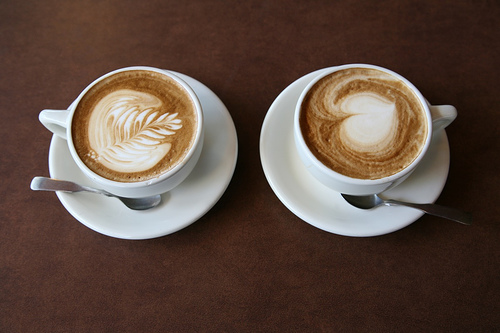
At the worst point of my restrictive eating, I used caffeine to give me the energy that I was not willing to get from calories. I frequently drank caffeinated beverages before meals in order to stave off my desire to eat and postpone the meal itself. In recovery, I relied on caffeine as a sugar substitute: that is, when my body wanted to binge on sweets, I drank coffee instead, or bottles and bottles full of diet soda, willing my body to stop wanting sugar. It may have worked at the time, but it left me with a potent caffeine addiction that I have had a difficult time weaning my way out of.

The reason that I am considering doing so now is that my breasts have felt tender and rather lumpy lately. I had everything checked out through the proper channels this week; my symptoms are benign so I'm not going to make a will any time soon. But the bad news, if it can called bad, is that this discomfort may be due to my high caffeine intake. And here we go again: to restrict or not to restrict. No coffee? No black tea? No chocolate? (I suspect that the last one is going a bit far -- how much caffeine can there possibly be in an ounce of chocolate?)

I have a few thoughts about this. The first is "Oh, yay, now I can finally have a good reason to end my energy dependence on foreign fuel." Caffeine makes me jumpy and irritable, interrupts my concentration, and turn me into an insomniac. I'm not sure what the upside is to it. But my second thought is "Waaaaaaaaaaaaaiiiiiiiiitttttt a second. W-w-w-what? No caffeine? Ever? Again? How am I going to get through graduate school?" That is my instinctive fear: that I will have to end something, to let something go that I am not ready to say good-bye to. Addictions are never easy to relinquish, but to make matters worse, I live in a city with a Starbucks on every other block.

And my third thought?: "My breasts are definitely worth it."
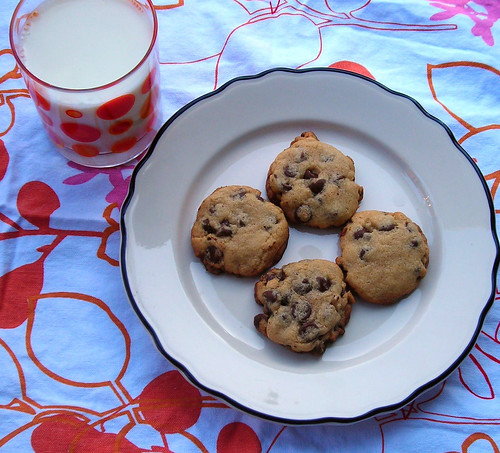
I'll take it slow, go cold turkey for now, and then see how a cup (no more) of joe affects me from time to time. But there will be no drastic end to the chocolate: the caffeine in chocolate is miniscule in comparison with coffee and tea, and I'm sure that a chocolate cookie from time to time would be just what the doctor ordered...


Note: None of my own images this time around. Click on them and you will be re-directed to their Flickr pages.

10.31.2008

The right to privacy

Tonight my husband asked me if I had told anyone in my graduate cohort about having had an eating disorder, and how that experience brought me into clinical psychology. I have not told anyone yet, and may not do so for a very long time, if ever. Even within the field of mental health, there is still some stigma surrounding the admission of mental illness by its practitioners. When I was applying for Ph.D. programs in clinical psychology, for example, I studiously avoided any mention of eating disorders or my own experiences in therapy. It wasn't hard to do -- I had a story ready for anyone who asked me how I became interested in psychology, and though it is only part of the truth, it was enough to keep me feeling authentic.

The other night, however, I heard what was perhaps the best explanation yet for why psychologists and psychologists-in-training might want to think twice about letting other people in their profession know about their own histories with mental illness. I was at a meeting about externships in neuropsychology, and a member of a panel discussion strongly advised the students in the audience to avoid putting too much personal information in their application essays. "In this profession [clinical psychology], it is necessary for us to know how to maintain personal boundaries, and part of what you show us in writing an application essay is how well you will be able to maintain those boundaries in your practice."

Hearing her words, I felt a sense of relief. So I wasn't the only one hiding my past! And nor was there anything to be ashamed of in doing so -- in fact, it is de rigeur in the profession! In a sense, this speaker gave me the permission to do what I have instinctively done: protect my most fragile self, maintaining my own space in the midst of so much talk, and study, of mental illness. This is my experience, one that I am willing to write about here, but one that will remain unknown to my professional colleagues, at least until I know better.

For the meanwhile, I am grateful to have this space to write about eating disorders, food, and my own experiences. In this way, I have an outlet for all of the opinions that I am forming about eating disorders and a way to work out the experiences that still trouble and inspire me. I have a community here of fellow travelers, people who speak with the raw honesty of having lived through an eating disorder: they know, as I do, distress from the inside.

I am committed, for the next five years, to understanding distress from the outside, from the scientific, clinical viewpoint. But I am also committed to you, my reader, and to this, this process of writing out and writing through my past pain, in order to come to grips with all that I bring to my profession and to my present.

10.28.2008

Part 2: Why I no longer restrict my diet

Written on October 26, 2008
What does restricting food mean to you?

Does it mean eating less of something you really like?

Avoiding it altogether?

Or does "restriction" mean eliminating whole categories of food from your diet (e.g. dairy products, meat, white flour, sugar, caffeine) without ever hoping to eat them again, whether for health or other reasons?

As I think about this, I am amazed by the sheer number of ways that we have to restrict what we put in our mouths. Indeed, the more choice exists out there, the more choices we have about what to eat and, consequently, about what not to eat.

Try it: instead of saying what you will eat today, say what you won't.

For example: Today I won't eat Twizzlers. Today I won't eat beef Wellington, or strawberry ice cream, or pork potstickers. Today I won't drink orange juice or champagne, I won't nibble on plantain chips or peanuts, and I certainly won't consume baked Alaska.

The list could go on and on because, to tell the truth, on any given day I eat far fewer foods than those which are actually available to me; every meal is a lesson in choosing what and how to eat; every meal an opportunity to say "no" more than "yes".

So what am I saying "yes" to today, and what does this have to do with restriction?
  • Breakfast this morning was a couple of sweet potatoes, baked yesterday afternoon and let to mellow, with a slice of Cowgirl Creamery cheese and a mug of milky coffee.
  • Lunch will probably be a bean sprout salad with dried figs and pumpkin seeds, followed by a bowl of yellow split pea soup, if I can manage to pull this all together by noon.
  • I am meeting a friend at the Hungarian Pastry Shop to study this afternoon, and I'm planning to eat a piece of their apple cake, and try to figure out what it consists of so that I can make it myself with all of the fresh apples that abound in the farmer's markets these days.
  • Dinner? A bowl of fresh cheese ravioli that I brought home from the Bronx's own Little Italy, Arther Avenue, accompanied by sauteed kale.
Of course, any and all of this may change. I am planning to go to the farmers' market later this morning, and depending on what treats they can offer me, I'll change any and all of this menu.
But my point is this: I can only eat so much in a single day, so there is necessarily some limitation to what I am eating today. The variety comes in the breadth of what I eat: my day's menu includes milk, red meat, cheese, white flour, and dessert -- as well as plenty of vegetables, fruit, and nuts. Over time, too, there will be variety, as tomorrow's menu will surely be different from today's. Breakfast will be yogurt, not sweet potatoes; lunch may be rice and beans, not soup; and so on and so forth. Every day I restrict in some ways, because I cannot eat everything that I would like at once (bye-bye, bulimia!), but every day is somewhat different from the day before, and I feel that it all rounds out in the end. Some days may have more desserts than others, some more vegetables, others more milk and popcorn.

To not restrict my diet is to also not beat up on myself when I eat more of a certain food on any day than I normally would like to. Not restricting means acknowledging that there will be those days when I eat more, and others when I will eat less. I have learned to trust that the "more" days will be balanced out by the "less" days, but of their own accord, without my having to do much to push them in one way or another. And though this sounds complicated and calculating, it works for me!

Have you experienced anything similar recently? How do you feel about the restrictions that you may have put in place for yourself? How do you respond to other people's restrictions (a topic for a future post)?

With love,
Ai Lu

10.26.2008

Part 1: Why I no longer restrict my diet

A series of comments back and forth with Emily Jolie have had me thinking about restriction, structure, and boundaries in our diets. I think most people who have struggled with an eating disorder can agree that food restriction plays an important, if not central, role in maintaining disordered eating patterns. These problems can be compounded if, like Emily and me, you have developed certain food sensitivities, or allergies, in the course of your travels.

Soon after I stopped binging and purging in 2004, I came down with a severe case of mononucleosis, and at the same time my digestive system went haywire. Apart from my daily exhaustion, I was also bloated, gassy, and miserable, and I spent my evenings doubled up with intestinal cramps, wondering what had gone wrong (and suspecting that I was somehow to blame). In consultation with doctors, acupuncturists, and chiropractors, I identified certain foods as being related to these symptoms -- primarily wheat and other gluten-containing foods -- and so I stopped eating them.

This restriction, at any other point in my eating disorder, might have acted as a trigger, but I had several things working in my favor. First, I was working with an amazing team of therapists, both official and unofficial (i.e. guardian angels). Second, I really, really wanted to get well; coming down with mono in the midst of training for a marathon was a true wake-up call for me to start treating my body right. That autumn, I replaced long-distance running with yoga; I gave myself permission to take naps in all matter of places on campus; and I re-evaluated my eating patterns. Honestly, I don't know if I could have pulled myself out of bulimia without having had mono first: being so sick as to almost be dysfunctional left me no time for my eating disorder. Instead, I had to concentrate on the things that were truly important to me, like graduating from college, spending time with my boyfriend (now my husband) and planning for life after school.

Instead of seeing my digestive problems as reason to stop eating altogether, I took them as a sign that I needed to re-evaluate my diet, among other things. During my active eating disorder, I rarely ate carbohydrates apart from binges -- I reasoned that I was getting enough of them anyway in my binges, so why add fuel to the fire? When I stopped eating wheat, not only did I rule out many of my former "binge" foods -- a fortunate side-effect -- but I began to notice, over time, that I felt better if I had some kind of whole grain every day. Living in China and Brazil after graduating from college, I started to perform nutritional experiments on my own body, packing my purse with soy milk and sweet potatoes, then apples and fresh cheese, as I explored these new countries and settled back into the rhythms of my own body.

Like Emily Jolie, my body has, at times, reacted strongly to certain foods, in a way that seems outside of my control. Living within the bounds of these restrictions was liberating in the sense that I had to be creative with my diet, looking beyond the obvious food choices. In China, I discovered fresh soybeans (mao dou), mutton skewers, egg pancakes, and any number of strange and marvelous vegetables. In Brazil, I ate cheesy bread, mangos aplenty, dried bananas, fresh fruit juices -- and I learned to make beans, oh delightful beans! The year after college, I took full responsibility for my diet, and began to cook for myself. I consider my eating disorder to have ended at this point, a year after I stopped binging and purging, because it took that long to learn how to eat again.

Now I will eat nearly everything. My digestive problems cleared up considerably under a no-gluten diet, but even so, this summer I decided to embark upon another experiment: eating wheat again. It has gone swimmingly, so much so that I can now say that I no longer restrict any part of my diet. Was this a goal of mine? No, not specifically: my goal was to find a way of eating that sustained my health, with or without gluten. It is a happy circumstance that now I can eat gluten, but I hope that I would feel just as free and just as flexible towards food if some of those restrictions were still in place, as they are for many people with food sensitivities and allergies. As Emily Jolie says, there can be freedom within boundaries. In my case, my old boundaries prepared me for the freedom I currently face, a freedom that would have been overwhelming if I had not taken the time to sound out the limits of what my body could take.

May all of you find some joy in food today, and some freedom within whatever limits you find yourself facing.

~Ai Lu

10.18.2008

Cooking to support health

At a party the other night, I met a woman who is attending a school in New York called the Natural Gourmet Institute, whose mission is to train chefs in "health-supportive culinary arts." The idea, she told me, was to learn to cook whole foods for individuals who may need to make dietary changes because of illness, such as beginning a low-salt, low-meat, or high-fiber diet.

This is an intriguing premise, but I had to ask her: "How would you cook for individuals who have had eating disorders, and may have problems with restrictive eating to begin with?" She didn't have an answer right away -- she had only just begun the program this fall -- but she promised to get back to me about it.

Our exchange got me thinking again about food trends like the raw foods diet, the whole foods diet, vegan diets, and others that promote some form of restrictive eating in the name of health. I am usually uncomfortable around true adherents of these diets, or at least around those who are in a proselytizing mood, because I generally believe in the equation restriction --> binge. In certain yoga studios and other New Age gathering spots these kinds of diets are quite common, especially in combination with other self-purifying practices, and my tolerance for such drivel is really quite low these days. (Self-disclaimer: I practice yoga, too.)

That's not to say that I don't think that whole foods are important. But what does "whole foods" really mean? I am reminded of that classic anthropological text, The Raw and the Cooked -- haven't we humans been modifying our food for quite a long time? How whole is whole enough? Which food arts are too artificial? How can we support our health with whole foods without going crazy about the meaning of "whole"?

In my personal experience, bringing back whole foods into my diet was an important part of recovery, as the more whole grains, legumes, and leafy greens I consumed, the fewer cravings I had for sweet, high-fat foods. These foods, besides being filling and delicious, are also quite easy to prepare, and these days they fill the bulk of my diet. But I also enjoy things like white bread and cookies from time to time, and I've learned to believe that how you act towards food is more important than what you put in your mouth. That is, rather than worry so much about what I am eating, I would prefer to direct my energy towards how I eat.

For example: instead of chastising myself for eating white pasta (oh, horror!) for lunch yesterday, I find it more useful to celebrate the fact that my husband and I enjoyed the one free weekday we both share, and took off an hour in the middle of the day to make lunch together. He prepared the zucchini and cream sauce for the pasta, while I made a red lentil curry so spicy that it cleared out our sinuses completely.

This was not a "perfect meal" in the whole foods sense, but it was such a happy meal, such a complete dedication to each other and to the communion of good food, that I cannot consider it bad. And that, fundamentally, is the issue that I take with certain health-promoting diets that seem not to consider the meaning of our food, above and beyond its health benefits. This meal brought back our summer in Italy, with its zucchini and pasta, and ushered in fall with a hearty stew, all in one fell swoop. It joined my husband and me together in the bright hours of midday, and reminded us of the importance of doing things for ourselves, with our own hands, at a time when there are so many demands on our brains from all sides. This meal, if any, supported our health -- and I am glad to eat this way.

10.12.2008

Am I promoting food porn? Please weigh in.

I am giving you the most luscious images that I can pull out of my camera today, because I want to ask you a question: am I promoting food porn on my small corner of the interweb?

What is food porn? you may well ask. Please see the following wikipedia article on the topic for more detail: food porn 101. In brief: food porn is the use or distribution of salacious images of food, often used in advertisements, that suggest the consumption of food as a substitute for sex, or the consumption of food porn as a substitute for food.

To quote wiki: "In much the same way that pornography can be a vicarious substitute for actual sexual relations, 'food porn' is seen as a substitute for actually cooking and eating the food in question."


Hence the problem. Am I unwittingly encouraging you to substitute food photos for actual food?

I post nice images of the food that I make here on my site about food and eating disorders, and some of you may be wondering: what is she doing? Is this a kind of "have your cake and eat it too" endeavor? Am I trying to tempt myself or tempt others? What is going on?


If you haven't been here from the beginning, let me reassure you that my intention is not to enable food restriction among my readers. Quite the contrary. I make good food because I eat it; I share it with you not to sell a product or allow you to vicariously experience my dinner, but because I want to share my love of food with the kinds of people who may need that love the most: people who suffer from disordered eating, in one form or another.


I made this food by hand, laboriously and carefully, for myself and for the people I love. I share it with you, my readers, because I want to encourage you to do the same. I hope that, if you are afraid of some aspect of food, you can feel emboldened by my images and my stories, and begin to cook again for yourself. I want to help you to expand your notion of what food is, because I believe that restricted notions of what food is may also contribute to eating disorders. This is why I post these photos, and why I take such care in documenting the food that I eat -- because it is really quite ordinary, and yet marvelous, to be able to care about food in this fashion.

What do you think of "food porn"? Have you come across this term before? Are you a "consumer"? Where does the line get drawn between food images that help you in maintaining a healthy attitude towards food, and those that don't?

~Ai Lu

10.11.2008

Antojitos

What drives our food cravings?

I am not talking about hunger, but rather a craving, a deep desire, for a particular kind of food, the kind of cravings that pregnant women get. What makes us yearn for tangerines or beet soup or raisins?

There is a delightfully descriptive word for these kinds of cravings in Spanish: antojo. An antojo, according to the Real Academia Española, is a “sudden and passing desire for something,” usually food. However, I rarely experience such fleeting passions: mine tend to stick around for a while, like the yen for authentic Asian food that has driven my cooking as of late. I think that it is important to listen to such cravings, because they often point to a deeper yearning.

For example, when I was just coming out of my eating disorder, I craved dark, leafy greens – not salads, per se, but chard and kale and collards and beet greens. I couldn’t seem to eat enough of them, and the health benefits were the last thing on my mind. I wanted green. In Beijing, it was practically a standing order for me at the restaurant: at every meal, I would ask my husband to get liu cai (green vegetables), and I would content myself with whatever else he ordered as a main. I ate copious amounts of bok choy that way, as well as spinach, watercress, Chinese broccoli, mustard greens, and other rare species.

Lately I have felt a similar antojo, towards vegetables and whole grains. I want to discover vegetarian mains again, and renew my love of beans as the weather get colder and the nights longer. There is nothing heartier or more heart-warming than a bowl of piping hot beans after a long day running up and down the island of Manhattan. A few nights ago I made my first authentic-tasting Indian dal, according to Chuan, and we have been eating the spicy leftovers ever since.

For me, vegetarian food is grounding, especially beans and whole grains and root vegetables -- exactly the kinds of the things that are right for this season. So tonight, when I go out to dinner with friends, I'll be looking for eggplant pasta and broccoli au gratin, borlotti purée and turnip cakes. I am not sure what this means: am I trying to share in the bounty of the fall harvest? Am I looking to set down roots even as my life is changing in drastic and surprising ways? Am I reminding myself of my agrarian heritage, even as I become more and and more of an urbanite? Or is this antojo biological, running through my blood and coursing out in my hormones?

So much for long-term passions: this one is brief -- I am hungry, and my husband is almost out the door!

10.08.2008

Surrender

My body is changing.

I know, I know -- it is always changing, mostly in mundane ways: hair falls off; skin follicles shed; my hands gain calluses and my legs, bruises; wrinkles form in unusual places; I age. I know this. I know that these changes are part of the human contract: we agree to them in living these fallible lives. We cannot be perfect.

But, I want to say in response to my wiser self, My body is different. See? It hasn't changed a wink in over two years, and now this! These new pounds, right there! What is going on? It feels disorienting to face a new body in the morning, even if there's nothing objectively to dislike about that body. There was comfort in having things stay the same these last few years, especially as my eating learned to take care of itself; the last thing I needed was a body that went willy-nilly. For a while, I had even learned to trust my body, and to trust that it would tell me what it needed. This recent spurt of weight gain has called into question some of my trust.

Nevertheless, although I am uncomfortable with some of the changes that I feel in my body, there is nothing that I want to do to change them (unlike in the past). I don't want to eat less -- I know where that road leads down, and I don't like it one bit -- and I don't have the energy or the inclination to exercise myself into oblivion.

In fact, I am quite resigned to not doing anything, in particular, to fight or mold my body. These attempts are mostly futile, anyway. Both scientific research and my own experience shows that restriction sets one up for binges, or worse, and that most weight lost on diets is quickly gained back. So there goes one more myth, one more attempt to be someone or some body I am not. It is sad, in a way, to see that myth go: to recognize that I can't touch it again, or it might kill me.

And yet -- with what can that myth be replaced? For it needs a replacement, or it won't die easily.

Where do I learn to be a woman who loves her body no matter its shape? Where do I learn to surrender to the changes that occur, those monthly and yearly fluctuations that may or may not mean anything larger?

Right now, I am trying to look for meaning in the rest of my life, to reassure myself that there are better things worth worrying about than whether or not my pants are tight. It is interesting how life, right now, has presented me with so many more worthwhile endeavors than body sculpting. I hardly have time to be fretting about my waistline, and so it has turned into a series of conscious choices:
  • I can envy that other woman on the train for her pencil-thin legs, or I can dedicate myself to memorizing neuroanatomy while traveling uptown.
  • I can question my lunchtime decisions, or I can pay attention to my professor's lecture in my afternoon class.
  • I can worry about whether I am dressed attractively, or I can listen to a patient's concerns.
  • I can spend my evenings exercising, or I can eat dinner with my husband.
  • I can hate my body, or I can love and appreciate it.
Bit by bit, these are the things that are replacing the myth of the perfect body. It doesn't take an idiot to see that they are far more worthwhile endeavors than resurrecting an eating disorder. But that is not to say that it isn't difficult, now, to trust that this is what I need to do, and to surrender myself to larger cycles and larger concerns.

I would love to know: what is your replacement for the myth of the perfect body?

How do you stay sane in the midst of constant change?

9.24.2008

Finding food

(This is in response to a few comments on my last entry.)

Food and emotions. Do you have a hard time separating the two?

I used to. I still do, sometimes. But I'm learning to tell the difference, which is actually a pretty cool skill to have. I know plenty of non-eating disorder folks who haven't gotten the memo on it yet, either.

There is a big difference, I think, between using food to stand for your emotions and having emotions about food. The first can be problematic, but I think that the latter -- recognizing and expanding our emotions towards food -- is part of healing itself.

I know this is not clear yet, so let me give you a few examples, starting with all of the meanings that food have (an anthropological perspective). Food may mean fuel to you, or warmth, or love, nourishment, pleasure, guilt, reward, sin, happiness, delight, punishment, satiety, sensuality, taboo, connection, home, embodiment, blessing, or burden.

Any more? Please do share.

I think that part of what happens with eating disorders is that the meanings that food can have are severely reduced, just as the actual food consumed may be restricted or limited in variety (hell, we always binge on the same old things -- don't we?). For example, to someone with an eating disorder, food rarely means pleasure or nourishment. In fact, food is more often a burden or a sin to them. But even people who don't have eating disorders may have difficulty connecting with the delights and blessings of food, so trapped are we in a culture that equates denial with virtue.

One reason that I have turned to food magazines and other food media is that they have helped me to expand (diversify!) my attitudes towards food. Food is not uni-dimensional: quite the contrary. Food has so many meanings, not only here in the United States, where I write, but in the thousands of cultures that exist across the world. Food should be diverse, as anyone who has ever consulted a nutritionist knows. We are made to eat many things, at many times, in many moods. It is not bad to have emotions about food. What can be harmful is when food replaces emotions, or when we have too few emotions about food.

People who are in recovery from eating disorders are often told "Don't focus on the food!" I was, and I have had plenty of time to think it over. In conclusion, I don't quite buy it. I think that part of recovery is learning to cultivate a new relationship with food, not to exclude it from one's thoughts altogether, nor to eat like an automaton. When we are having a problem with someone we love, we usually don't solve the problem by exiling that person from our lives; and yet, recovery from an eating disorder is often painted as a sort of exile from food, or from food-as-emotion, without realizing that there are so many different emotions that can surround food, and not all of them are harmful.

This is what I have learned to do in recovery, and here is my challenge to you: find a new meaning for food in your life. Add it to the ones you already have. Right now. Pick one that I listed above, or add a new one of your own. Maybe you lean the other way: you already enjoy food, but you don't think of it as physical fuel or nourishment, or you are disconnected from the sources of your food. In any case, look at food from a new angle. Visit epicurious or culinate or the slow food blog. Pick a recipe or an ingredient, a cuisine or a cause, a farm or a feedlot. Learn something new that you didn't know about food. And then think about where you are, and how that knowledge is changing how you feel about the food that you eat every day.

And let me know how things are going, OK?

~Ai Lu

P.S. GRM, Tiptoe, Emily Jolie: I had so much to say to your comments these last few days! Thank you for giving me so much to think about.

9.23.2008

What work is there but this?

These days I have been thinking a lot about recovery, as I receive comments and emails from readers of this blog, encouraging me in my unabashed rediscovery of good food.

When I sat down to write my personal bio on this blog, I struggled with setting a date to my recovery. It was important for me to indicate to you, my readers, that I was writing from a place beyond the disorder, I wanted to offer some of what I have learned in the process to other women who are going through what I went through four or five years ago. I felt that there are simply not enough models for life after recovery, and I wanted to be one.

So that was the confident side of me, the one who thought she knew everything about recovery and how to pass it on.

It surprised me a bit to realize, over the course of the months that I have been writing, that my recovery is not a staged event, but an ongoing revelation. Since I began to write and participate in the ED blog community, I have changed. The ways that I look at food have changed. I am eating wheat again. I have fewer digestive problems. I am weighing myself less. I am less anxious about getting "enough" exercise. I look at women who are heavier than I am and don't feel sorry for them; and when I look at women who are thinner, that doesn't seem so appealing anymore, either. I am learning to rest with myself.

Perhaps writing is healing, in this case: through writing, I bring the past closer and find some way to integrate these disparate parts, these disparate countries, all of this whole and this emptiness that contain me. I am learning to be humble in this renaissance, to accept that this is not the end of the path, after all.

And if this is not the end, then it bedazzles me to think of how deep we can go. Life is an interminable onion, layer after layer after layer.

And yet -- what work is there but this?

9.18.2008

News gets around

My thanks to the anonymous reader who sent this link my way -- Tara Parker-Pope, for The New York Times, on "Eating Less or Eating Better." Her article reports on a sea change in the diet wars, as long-time dieters who are tired of the yo-yo effect are turning to simpler, more pleasurable ways to enjoy their food. 

This "new" philosophy is very much the one that I have embraced in my recovery from an eating disorder, though no mention was made of eating disorders per se in the article. Although I don't necessarily use weight as an indicator of health, I was interested to learn that the more time that people spend preparing and cleaning up their food, the more likely they are to be at a middle weight, as opposed to "underweight" or "overweight." In my own experience, preparing my own food has been absolutely central to recovery from my eating disorder -- but I had no evidence for this other than my own experience, until reading this article.

The truth is, I don't read a lot of research regarding nutrition or eating disorders, but this article has me asking myself if maybe it is time for me to pay a little more attention. 

Although I don't write about it much here, in my other life I am a doctoral student in clinical psychology; I spend most of my time reading scientific publications about mental disorders and their treatments. It is certainly within the realm of possibility for me to spend a few hours researching the most current news on eating disorders. But, until now, most of what I have stumbled across in the way of eating disorders -- both in the journal articles and in the persons of the researchers themselves -- has been less than appetizing. 

A few years ago, I worked briefly as an intern in an obesity research clinic whose main project was to enroll participants in a liquid diet and monitor their weight loss while providing "supportive" counseling. Their secondary project was to give group therapy to patients considering bariatric surgery. Fortunately, I did not have to work there long, because I had a lot of misgivings about liquid diets, bariatric surgery, and the attitudes of the researchers towards the patients ("People are obese because they overeat. Period.").

Before that, I had applied for a job as a research assistant at a prestigious center that studied eating disorders. In my application for the job, I was forthright in revealing my past history -- having an eating disorder had made me very interested in eating disorders, after all, and very motivated to work in that field. I ended up in one of the most uncomfortable interviews in my life when a psychiatrist on the team asked me, while looking me up and down, if I had been "a normal-weight bulimic." The nerve! I withdrew my job application immediately and wrote a terse email to the study director, who had gone to my same alma mater, telling her that I had considered her colleague's behavior in an interview absolutely inappropriate.

And that was the end of my great career as an eating disorder researcher.

I got another job, in public health, and haven't looked back. Within psychology, I love studying health psychology -- understanding the connections between mental and physical health -- and I'm not likely to give it up to pursue eating disorder research at this stage of the game. What I write on these pages is personal, not scientific. I form a sample size of 1, hardly a reliable study design. My words are the stuff of clinical anecdote; at best, I am a case study. 

And yet, and yet -- I have the tools at my disposal to find and understand the research that is coming out. I may disagree with much of it, especial with nutrition science, but that's no reason for me not to look it in the eye and evaluate it for what it is, flaws and all. One thing that I love about the scientific method is its willingness to test out its hypotheses, even if they might be wrong. Although I am trained in this method, which is designed to examine external phenomena, my body has always been my first site of investigation -- as it is for all of us. 

These last three or four years have been an exercise in getting to know my body better, in empirically testing what works for me. If you have been reading, you know what I have found: eating whole foods that I cook has been the best form of therapy that I could imagine. Do I have the evidence to back it up? Not now, but I'll look into it.

Until then, will you accept the following? A breakfast of mung-bean and coconut porridge and tangerines, taken around 7:00 am this morning:
 

The proof is in the pudding, as they say.

~Ai Lu

9.15.2008

Facing our fears

Last week I played around with blogger a bit and discovered the "survey" function. A few of you responded to my survey on "foods you are afraid of" -- thank you! -- but, being a social scientist myself, I realized that I started with the wrong kind of study design in the first place. What I should have done was to first elicit answers from you, my readers, and then compile a long list of "food fears" divided into major categories, perhaps things like "food contamination," "foods that are perceived to be unhealthy," "food exotica," etc. Instead, I started with some of my own fears -- past and present -- and assumed that yours would be the same. Are they? What are you afraid of eating? What do you avoid? Which labels do you read? Feel free to leave comments below. If I get enough responses, perhaps I can even venture a few generalizations...

I'll confess myself: I read labels to see what is so chock full of preservatives that it would last a nuclear winter; to guestimate the number ingredients are in the food (too many scare me); and to see if anything in the first few ingredients says "hydrogenated" or is otherwise unrecognizable as food. But I don't buy that many packaged foods anymore, so this is less and less of an issue. I owe all of this to Michael Pollan's influence. (If you are interested in food and our "national eating disorder," as he would say, The Omnivore's Dilemma should be required reading. But you don't need me to tell you that, now do you?)

As for other fears: I have been known to drink the water in foreign countries without a second thought; 
I used to have a terrible fear of ice cream because it was so difficult to stop eating; antioxidants are good but they aren't everything; and I never much cared for French fries past the age of 13 or so. You won't catch me eating bugs -- yet -- and industrial meat scares me but I still eat it because we can't afford to shell out the extra money for free-range moo-moos and oinkers, like the ones at left. (By the way, more people voted for "industrial meat products" as a fear-inducing food than anything else.) I prefer my vegetables organic (who doesn't these days?) but I don't terribly mind conventionally-grown products. 

In my experience, every effort to restrict food comes with its own madness. And so I prefer to expand my palette, to focus on what I can have and want to have, as well as what I can make with my own two hands, rather that what I cannot eat (for invented, monetary, or biological reasons). Fear can expand in strange and unexpected ways, taking up far more of our attention and energy than was our original intention when we first decided to "cut back on cholesterol" or "eat only raw foods." I would rather nip such fear in the bud by facing it head on -- by making the foods that once scared me, such as ice cream and butter, wheat bread and chocolate cake. Cooking is my remedy for food fears.

I don't have any experimental evidence to back up my claims yet -- my research interests in food are still limited to my own narrow experience -- but I believe that cooking food for oneself and others is one of the best ways to jump out of the diet rut that we too often find ourselves in. Cooking has also allowed me, perhaps ironically, to stop obsessively about what I think is in the food (fat, sugar, wheat) and actually take part in the food's making. Butter, sugar, and eggs seem a lot less frightening when you are putting together a cake for a loved one, and not thinking about your waistline. Ditto for meat and salt: when you're participating in a collective barbeque, a fear of bloating should play second fiddle to your delight in the conversation and the smell of the grill. For me, this is what cooking has allowed me to do: pay more attention to the food itself, and less attention to my fears and my obsessions.

Perhaps this is why, of all the possible food fears, packaged foods feature so high on my own list: devoid of character, practically devoid of origin, they are disorienting and deceptive; they are, I think, what got me in trouble in the first place, what spurred on my eating disorder. There is not much of the libertarian in me, but when it comes to industrial products, I feel the urge to go down to Times Square on a Sunday afternoon and wear a sandwich board that reads "GET OUT OF MY FOOD." Perhaps I won't be as entertaining as the Naked Cowboy, but at least I'll have had my say.


9.14.2008

Another one bites the dust

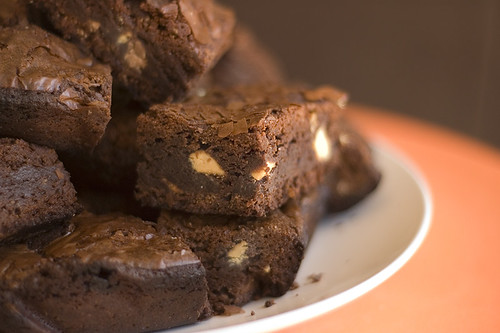
Tonight I went to a potluck dinner, bringing a nice cheesy bread that I found in the new Bon Appétit, and leaving with someone else's brownies. 

"Please somebody take these home with you. I cannot have them lying around my house," another woman said. And so, as nonchalantly as I could muster, I scooped them up. Why not? I knew that they would freeze well, and make an easy dessert with a side of vanilla ice cream. (Besides, I had a husband waiting at home who, poor dear, had been studying all night and had only had a wee sliver of my cheesy bread before I left. I think he ate pre-frozen dumplings for dinner.) These weren't particularly special brownies -- I think I heard someone mention that they might have come out of a mix -- but something in me was just tired of letting other people worry about food around me, of letting other women air so many of their food problems in public. And so I wrapped them up in left-over tin foil, and brought them home. 

I know very well why I "shouldn't" have taken those brownies. First, I used to have an eating disorder which, in its most severe form, was the kind that made me want to lock up everything in sight so that I wouldn't eat it first. In those days, potluck dinners would have been a real no-no, an easy excuse to eat all I wanted to with no one knowing any better. And, if I had taken the proffered brownies, I would probably have made short work of them on the way home, arriving at my own doorstep in utter panic and guilt. Those were the days, eh?

Second, if I should ever want brownies, there is nothing keeping me from making them myself. I don't even need Duncan Hines to do that. 

But tonight, I took the brownies without concern, for probably the first time in years. And, true to my promise to myself, they went right into the freezer when I got home, with nary another bite. I'll mention them to Chuan tomorrow, see if he wants them; if not, I'm content to just let them sit there, until we find a good pint of vanilla bean ice cream, or freezer burn destroys them.  

So, I say: another myth bites the dust, and another, and a third. I can have my cake without eating it, once in a while. I can free someone else of her brownies and be no worse for the wear. I can wait until another day to have a second helping.

Those brownies are safe in my freezer, and they'll come out only when and if I really want one.

And who said that brownies for breakfast were a bad idea?

9.09.2008

What if Julia Child was bulimic?

Consider the following (hypothetical) scenarios:
  • What if Julia Child was bulimic?
  • What if Martha Stewart is a food hoarder?
  • What if Mario Batali is a binge eater?
  • What if Ruth Reichl had anorexia as a teenager?
Disclaimer: I don't have any inside information here, and these aren't guesses so much as "what ifs." I could have mixed up any of these names and any of these conditions, and my point would have been the same: could you feel the same way about them as you now do? 

I am assuming, of course, that you feel anything about them at all; assuming that you even know who they are (that you live in the United States); assuming that you, like me, grant them greater power over their plates and their love handles than the rest of us have. 

How would you feel about the way that you eat if you found out that some of the greatest cooks and food critics have struggled with similar issues? How would your image of the food industry change if you suddenly started to see pathology, instead of pleasure, every time you opened up a glossy food mag?

I, for instance, when I read Ruth Reichl's food memoirs or her editorial welcome in Gourmet, invent a story in my head that she is one of those rare people who have no food problems. I imagine that she's the kind of person who can eat out every night, enjoy seven-course tasting menus at the drop of a hat, and ignore the early-morning alarm clock the next day urging her to get up and go to the gym to work off all of that goose fat. Her food writing -- like most out there -- is so awash in whimsy and delight that I can hardly believe that her food is the same as my food.


My food -- what is my food, exactly?

My food is hard won and hard gained. I swung back and forth on the seesaw of divine restriction and vulgar abundance before coming to rest here, somewhere in the middle -- some days higher, some days lower. Just nudging back and forth, gentle-like, like a pendulum in a light breeze.

My food takes effort. I could tell you about the times I beat egg whites by hand, and kept a low oven on overnight to dry apples, and gathered blackberries by the side of the road. My food is worth the labor that I have put into it, the dints of exertion, and the disappointments.

My food takes love. It is about nourishing the people I love, and learning to love the food that nourishes me.


This love of food took a long time coming. Anorexia, bulimia, call it what you will -- I am no poster child for food, I am no Thomas Keller or Alice Waters or Lynne Rossetto Kaspar. I don't own a trendy cupcake shop or eat at New York's most fashionable restaurants. But what if -- and this suggestion came by way of a friend who had worked in the high-end restaurant business -- my problems are not unknown among them? What if someone or other of these great food people has also found herself on the edge of alimentary madness, staring deep into the abyss of just another bite? 

These are the things I wonder about, when I borrow a recipe of theirs or plan my meals in advance or take secret pleasure in the color of an eggplant. Is this new just for me, this joy? Or have others struggled as I have, to at last see and touch and smell and taste, at long last? Were they born with something that I have had to acquire through long toil? Finally, does it matter whether our passion for food came from a lucky set of taste buds or a disorder, if we all find a way to love our food in the end?

9.05.2008

On not feeling afraid (of food)

This morning, as I prepared my breakfast -- a simple parfait of yogurt, blueberries, cereal, and honey -- I noticed that it is becoming harder and harder for me to identify foods that I "can't" or "won't" eat. 

Meat. Milk. Sugar. Chocolate. Wheat. Butter. Eggs. Slowly, these foods have come back into my diet, until my meals are no longer intricate dances around what I can't have. I have known that these changes were occurring, with every meal I have prepared for myself, or every restaurant excursion that didn't scare the daylights out of me, but it is interesting to stop here, in September 2008, and realize that there isn't anything that I am avoiding. 

A part of me feels sad to let these restrictions go, as if I were a bit naked without them. On the one hand, checking for restricted items in my diet was a way to reflect on what I was eating. I couldn't wantonly shove food into my mouth if I had to be concerned about whether or not it contained gluten, and might give me a massive stomach ache afterwards. On the other hand, food restrictions had become such a chore lately, especially in Italy, where I scrupulously avoided wheat pasta and morning brioche. 

Today, I can eat everything. Can is the operational word here, for while I can eat everything, I won't eat it all at once, nor will I eat it every day. But I still feel a little at awe to realize that, for perhaps the first time in six or seven years, I am not leaving anything out of my diet. Now, the foods that I avoid, if any, are the ones that I never liked in the first place -- hamburgers, canned olives, thousand-year-old eggs -- but I am more likely than ever to occasionally give these foods a try, too.

This experiment is somewhat frightening -- I am sure that some of you know all too well the comforts of sticking to a particular diet -- but I am trying to concentrate on the feeling of liberation instead of fear. Liberated from food fears, I can attend parties without worrying that I will scarf down every object in sight or eat something that will give me stomach pains. I can read restaurant menus and nod "Yes, yes, yes," to any number of items, instead of heading beeline to the low-fat, no-wheat options (and there are only so many raw salads that my digestive system can take before it rebels).  I can cook bread and biscuits and cakes for myself, make butter and mayo and salad dressing from scratch, prepare roasts and eat well. If this isn't recovery and happiness and eager fun, than I don't know what could be better.

And what of an expanding waistline? And what of the health consequences of so much cholesterol and fat? And what about simple sugars and -- and -- and -- ? 

There is only so much fear-mongering that I can take right now (we're in election season, after all). As for all of the rest, I will believe it when I see it. All I know is that by eating more, and by eating more widely, I am healthier and happier than I have been in years. 

So take that, diet gods!


P.S. See the new poll to the left -- which foods frighten you?

8.20.2008

Happiness is as happiness does


I have been reading a piece by Rachel Richardson called "Eating disorder inspires laughs" in the Disordered Times and thinking more about the mission of my blog (if I can even call it a mission).

I intentionally chose a light-hearted title for this blog, AVIDALEGRIA, which roughly means "eager happiness." When I began, I was hoping to write about the things that make me happy at a time when my job was not going well, my father was very ill, and my husband and I were facing some difficulty decisions regarding graduate school. Facing all of these stresses, I knew that I had to have something else to look forward to -- and so I cultivated my hobbies, devoted myself to my cooking and knitting and biking and friendship, and wrote about these things, to keep them with me and remind myself of all that was good and sunny and harmonious in my life.

You probably have these things, too, these pequenas alegrias (little joys) that soothe you when you are just about run ragged by everything else in the wide world. Your comforts may not be the culinary or fiber arts; you may be scornful of these things, or merely indifferent. And yet I venture a guess that you also know where to look when the bastards get you down; you also cultivate small worlds of delight and refuge. I wonder where they are, in what corners you hide when there are too many storms about.

From now on, you'll find me here, writing and snapping photos and composing blog entries, putting together bits of text and images in order to provide a counterweight to the darker moments of life. Because we need counterweights; we need joys to stand firm against our suffering, our fatigue, our despair. This is not to ignore the darker side of things, but to recognize that in order to give them a place in our lives -- to not run away or dull ourselves to those pains -- we also need what is light and precious and immutable, joyful and urgent and sublime. We need alegrias and rose water and beech trees, sea gulls and skyscrapers and tugboats, roosters and carafes and mountains.

Amen.

8.13.2008

Are you getting enough fiber? (the other kind)


It has been a while since I have written about my love for knitting on this blog. But if this summer has been the summer of cooking, it has also been the summer of knitting.

I saw a therapist once whose opinions I otherwise was not very fond of, but who had some interesting things to say on the subject of knitting. Knitting -- or any craft work -- can be an excellent distraction from eating (when one tends to eat too much; I don't recommend it for this purpose if your tendency is towards restriction). It's very hard to binge when you have two long needles in your hands and a pile of wool in your lap! It's also hard to smoke, to drink, to have sex, to do drugs (hey! -- that's an idea: substitute one kind of needles for another...). You get the picture. Knitting emerges as the sort of perfect compulsion control technique. Oh, cognitive-behavioral therapy!

To clarify: I did not learn knitting for compulsion control. I learned to knit when I was seven years old from my grandmother, and I have been knitting ever since. I knit during the lean years where there weren't any age-appropriate patterns (late adolescence, late 1990's), I knit before the celebrities joined the crew, and I am still at it, thrilled that there are so many young designers and online knitting resources, such as Ravelry.

With the help of that therapist, I was able to make the connection between knitting and that oh-so-lovely-feeling of being in the flow (thank you, Mihaly Csikszentmihalyi). Flow as in: uninterrupted concentration; delight; calm; connectedness. This is how I feel when I knit; once I recognized these feelings, I was able to harness this knowledge to use my knitting more deliberately, to replace more destructive hobbies.

If I feel the urge to eat after dinner, the worst hours of the night for me, I sit down with a knitting project and dedicate myself to it for at least 15 minutes. By that time, the urge has usually passed, and I am so engrossed in my knitting that it takes all my husband has to convince me to put it down to come to bed. Knitting, I find myself absolutely bedazzled by fiber and the infinity of combinations that I can produce with my needles and thread. I study lace patterns; compare color swatches; and linger over new designs. There is so much to knit, I don't have time to think about snacking or wander into the kitchen. Knitting, at times, has been my safe haven, a place to put all of my energy and concerns and anxiety, and spin straw into gold:


Take the sweater above, my best fit yet: the Katharine Hepburn cardigan, from Lace Style. I sewed on the last buttons while in Italy a few weeks ago, and now that I'm here in Minnesota, where the weather is cooler, I wear it in the evenings.

There is something so satisfying and so nourishing in creating a sweater -- the ultimate act of self-care, I think, is to dress oneself warmly. Knitting brings me deeper comfort than consuming any culinary dish, and produces more fuzzy-inside feelings than those famous exercise endorphins.

Here's to form meeting function!

8.10.2008

Summer reading

Now that I have thoroughly immersed myself in the food and eating disorder blogospheres -- not that they have very much in common -- I'm interested in knowing what other people are reading.

But first, a line-up of some sites that are worth the effort -- sites that are changing the way that I look at food and fat:

If you believe that the consequences of what you eat go beyond what ends up on your hips, the Slow Food blog -- "Good, clean, and fair food" -- is a good place to start. Especially with the prices of food and other commodities rising like Noah's flood, it behooves the consumer to start paying attention to where his or her food actually comes from. That, and food just tastes better when it doesn't come from a mega-farm.

Recipe central: Epicurious. Every recipe in the last five or so years coming out of Gourmet and Bon Appetit and some other minor Conde Nast publications. The best part about it? The search tool is really, really good. Put in "garbanzo" and "chard" and you'll come up with this year's number-one bean recipe. At least according to me and mine.

Real Food: This is actually a book, but the author has created a blog, too. Nina Planck's writing on food and nutrition preceded the much-applauded Michael Pollan's In Defense of Food, and in my opinion she takes the cake on this sort of food writing: more astute analysis of food science, less foodie self-righteousness. Read her book and understand why I started to eat butter and cheese again, and stopped being afraid of whole milk.

For more good, clean fun: food blogs. Check out Orangette, Gluten-free Girl, Smitten Kitchen for some food porn and otherwise harmless entertainment. Reading about these women's love of cooking makes it much easier to embrace one's inner chef, and to appreciate how much pleasure that food and cooking can actually bring to one's life.

And if you don't feel like honoring the domestic gods (Hymen, San Pascual, Juno)? How about The F-Word.org -- I love Rachel's slogan: "Food. Fat. Feminism." Now, which is the real F-word? It's up to you to decide. A compendium of articles and links about food, eating disorders, and body image with a feminist slant. Very empowering for those of us who still worry about the weight on the scale.

Speaking of weight, have you seen the different size charts out there? Such as Cockeyed's visual chart showing real people at real heights and weights? Or more visually appealing (and politicized): Kate Harding's Illustrated BMI Categories? These may be controversial enterprises -- I am not sure of the creators' intentions -- but I personally find it fascinating to see what 100 lbs, 150 lbs, 200 lbs, 300 lbs actually look like on people. It is also disturbing to see how people that I would consider normal-weight are actually considered "overweight" or "obese" by the medical establishment; this is no laughing matter when insurance premiums can actually go up for people with a BMI above a certain number!

So, what am I missing? What are you reading that I'm not?

A piece of cake, part II

I am happy to report that said cake consumption yesterday went off without a hitch.

No digestive problems, no urges to eat more (it didn't hurt that the meal before dessert was very good, too), not too much anxiety around it once I actually sat down and started eating. And saw that the cake was just....a piece of cake. Nothing more. Not a monster. Not a taboo. Just a piece of cake, lying on my plate.

And best of all? The cake tasted really, really good. Amazingly good. Moist and chocolate-y and just oh-so-cakelike.

Now, this doesn't mean that I'm going to spend the next few days in the kitchen baking up cakes and taste-testing them. Nor does it mean that I am back into glutenhood for good. What it does mean, however, is that I've passed a small barrier. I had a piece of gluten-containing, rich, sweet food, and it didn't trigger any digestive or emotional malcontent. Tomorrow it might be different. Who knows? But last night, the cake was fine. Whatever happens from here on out, I can look back to this piece of cake, and remind myself that things went really, really well. Is this repeatable? I certainly hope so.

Because cake without fear is a fine thing, indeed.

8.09.2008

A piece of cake (for the gluten-phobic)

The last month, I have been so inspired by some of the other food and eating disorder blogs that I have been reading -- like Emily Jolie's -- that I have begun to reconsider my no-gluten policy.

If bodily functions gross you out, skip down to the recipe below for zucchini chocolate cake and read that instead. It's guaranteed to not gross you out.

When I first recovered from my eating disorder, and began to eat normally after a few years of binging and purging, my whole digestive system was in serious trouble. It was as if it had forgotten how to move things forward, and every evening, without fail, I had body-stopping cramps that left me huddling on the couch with a water bottle on my stomach. I spent a miserable summer trying a series of "elimination diets" to see if I had a food allergy, and in the process learned that things seemed to get better -- a modicum of improvement -- if I eliminated gluten from my diet. I consulted gastroenterologists, allergists, chiropractors, acupuncturists, and nutritionists, with mixed success. I didn't like the GI doctors' advice to take anti-acids for the rest of my life, but I also knew that following a strict diet when I was recovering from an eating disorder could potentially put me at risk for more eating-disordered behaviors. So it was with caution that I adopted a gluten-free diet.

Miraculously, I have been gluten-free for almost three years, and it hasn't led me down the old road of restriction + binging. Absolutely the contrary. Because I couldn't rely on my old stand-bys of peanut butter sandwiches and Honey Bunches of Oats, I had to look farther afield, and start making my food myself. I didn't hurt that at this point I moved to China for four months with the man who is now my husband; living in a rice-based culture is much easier for someone who doesn't tolerate gluten well. But even after I left China for Brazil, it was as if a whole world of cooking and food opened up to me, once I was forced to cook for myself.

Cooking for myself is the ultimate act of self-nourishment. Cooking is what grounds me in a foreign country; cooking is what keeps me from going crazy about food. Cooking for others puts me in contact with my friends and family and shows them that I care about them, and allows me to spend time with them. Cooking has, in a sense, saved me from an eating disorder, and I am passionate about and respectful of food in a way that I could never be when it shared the bejeezus out of me.

Over the past few years, limited by my gluten intolerance, I have let so many other foods back into my life, foods that I never would have eaten during my eating disorder: red meat, whole milk, cheese, tuna fish, butter, mayonnaise -- the "bad" foods -- not to mention kale and beans and amaranth and sweet potatoes and beans and almonds and mangoes and sweet corn and brussels sprouts and did I mention beans? Like Shauna, the Gluten-Free Girl, by tailoring my diet to what I could tolerate, I was able to find "food that loved me back."

But this week I am going back to eating gluten. I am going to take it seriously, and see if we can tolerate each other again. It has been a long time, baby.

Which means: I know that I don't have celiac disease, that sometimes gluten makes me have an upset stomach (but mostly when I eat a lot of processed, white foods in overabundant quantities, a.k.a. binge), and that, in theory, I should be able to tolerate gluten. So what has been keeping me back? Fear, I think, of opening that door and letting in all of the foods that were once so hard for me to stop eating: cookies and candy bars, cakes and pastries and puddings. Conveniently, not eating gluten because I fear its consequences in my lower intestine has helped me to avoid binging on those very foods that once were so irresistible. Is it a coincidence that I developed an intolerance to the same foods that I once binged on? I think not. However, given what I know about my body, about eating intuitively and eating the foods that nourish me, I am willing to give it another shot with gluten. Especially since lately, even in the midst of Italian gelato and Perugian chocolates, I have been able to hold my own, to ask for food when I need it and stop when I am full.

And what better way to celebrate a return to glutenhood than baking a cake? Because I'm not afraid of cakes anymore.

When I arrived at my parents' house on Thursday, there was a mountain of vegetables in the refrigerator from their CSA share, and the clear injunction to do as much as I could to get rid of them. My mother produced an outlandishly sized zucchini and a recipe for zucchini chocolate cake, reproduced below. I got busy this morning and now have an entire cake awaiting my unwitting family.

The recipe:

Chocolate Zucchini Cake
(And please don't pretend that the zucchini makes this a "health" food. This is chocolate cake. Chocolate. Cake.)

Ingredients:
3/4 c. oil
1 1/4 c. sugar
2 eggs
1 t. vanilla
2 c. grated zucchini (I used less than half of my larger zucchini)
1/2 c. sour milk or buttermilk
2 T. cocoa powder
1/2 t. baking powder
1 t. baking soda
1/2 t. each ground cinnamon and cloves
2 1/2 c. flour
1 smallish bag of chocolate chips (however much suits your fancy)

Heat oven to 350 degrees, grease two round cake pans. Mix all ingredients and bake for 25 minutes. Glaze or frost if you so choose.